Why Precision Crop Spraying Is Changing How UK Farmers Protect Their Fields
The Shift from Blanket Spraying to Targeted Application
For years, the standard approach to crop protection meant covering an entire field with the same rate of agrochemicals, whether or not every patch needed it. That method works, but it is expensive and wasteful. A field rarely behaves uniformly. Some areas have thicker soil, others are sandier. Slopes drain differently, and pest pressure can vary from one corner to the next. The result is that a single application rate across the board either under-treats the stressed zones or over-treats the healthy ones.
That is where precision crop spraying comes in. Instead of treating a field as one uniform block, it treats it as a collection of zones, each with its own requirements. By using GPS guidance and field mapping, a sprayer can adjust the application rate in real time as it moves across the ground or, increasingly, as it flies overhead. The goal is simple: put the right amount of product where it is needed, and nowhere else.
I have spent enough seasons watching sprayers work to know that the old way still has its place. But the margins in arable farming are tight, and any input that can be saved without sacrificing yield is worth a serious look. Precision crop spraying is not a gimmick. It is a practical response to the reality that fields are not uniform, and treating them as if they were costs money.
How Drones Fit into the Picture
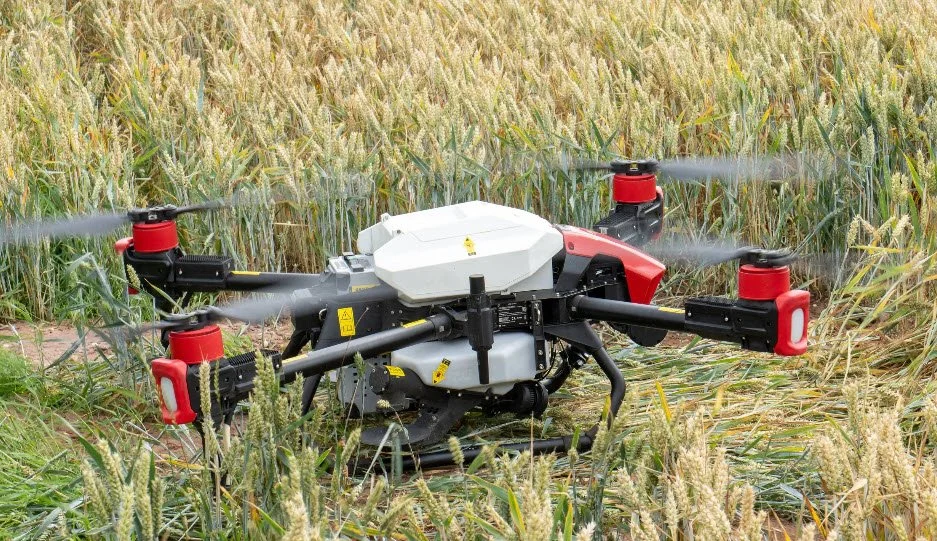
Ground-based sprayers have been the workhorse for decades, and they remain effective on flat, open land. But they have limits. They compact soil, they struggle in wet conditions, and they can only move so fast. Drone spraying changes the calculus. A drone can get into a field while it is still too wet for a tractor, which matters when a disease outbreak needs an immediate response. It can also work in smaller, awkward fields where turning a big sprayer around is a chore.
Autonomous drones are becoming more common, and they bring a level of consistency that is hard to match by hand. They follow a pre-programmed flight path, hold a steady height above the crop canopy, and release a fine, even mist. The downwash from the rotors helps push the droplets into the lower leaves, which is something a ground rig cannot always achieve. That matters for contact fungicides and insecticides that need to reach the underside of the leaf to be effective.
There is a learning curve, of course. Drone spraying is not just a matter of sending a machine up and hoping for the best. It requires careful planning around weather, especially wind speed, to keep spray drift under control. But for many growers, the trade-off is worth it, particularly on fields that are awkward to access or where soil compaction is a real concern.
Variable Rate Application and the Data Behind It
At the heart of precision crop spraying is variable rate application. This is the practice of adjusting the output of the sprayer, whether ground-based or aerial, based on data from the field. The data can come from a few sources. Soil samples reveal variability in pH and nutrient levels. Yield maps from previous seasons show where the crop struggled or thrived. And multispectral imaging, often captured by a drone itself, can show the health of the crop in near real time.
Multispectral imaging works by measuring light reflected from the crop in different bands, including near-infrared. Healthy plants reflect more near-infrared light, while stressed plants reflect less. That difference can be translated into an NDVI index, which gives a numerical value for vigour across the field. A grower can then use that map to direct variable rate application, increasing the rate in areas where the crop is lagging and reducing it where the crop is already strong.
The practical benefit is twofold. First, it saves money on inputs, because you are not wasting product on areas that do not need it. Second, it can improve yield optimisation, because the crop gets exactly what it needs, no more and no less. I have seen fields where the difference in NDVI between the headlands and the centre was stark, and a uniform application would have either over-treated one or under-treated the other.
The Role of Weed Detection and Targeted Spraying
Weeds are one of the biggest headaches in crop production. They compete with the crop for water, nutrients, and light, and they can harbour pests and diseases. Traditional practice is to spray the whole field with a pre-emergence herbicide, or to walk the field and spot-spray with a knapsack. Both have drawbacks. Blanket spraying is wasteful, and walking the field is slow and relies on the human eye catching every patch.
Precision crop spraying offers a better way. With weed detection, either through camera-based systems on drones or through image analysis of field maps, it is possible to identify weed patches with remarkable accuracy. The sprayer, whether a drone or a ground rig, can then apply herbicide only to those patches, rather than to the entire field. This is targeted spraying in the truest sense, and it can cut herbicide use by a significant margin, sometimes by half or more, depending on the weed pressure.
There is a caveat, though. Weed detection is not perfect. Small weeds are harder to spot from above, and some species are more cryptic than others. But the technology is improving fast, and the savings are real. In a season where agrochemical prices are volatile, being able to use less while achieving the same level of control is a big deal.
Nozzle Technology and the Problem of Spray Drift
One of the most underappreciated aspects of precision crop spraying is nozzle technology. The nozzle determines the droplet size, and droplet size determines how the spray behaves in the air. Fine droplets drift more easily, but they give better coverage. Coarse droplets are heavier and less prone to drift, but they can bounce off the leaf surface. The trick is to find the right balance for the conditions.
Drone spraying has its own nozzle challenges. The rotors create a downdraft that can affect droplet distribution, so the choice of nozzle and the height of the flight matter a lot. Many drone operators now use nozzles that produce a controlled droplet size spectrum, reducing the risk of drift while still covering the target. This is not just about being a good neighbour, though that matters. Drift means product is not landing where it should, which is a waste of money and can damage neighbouring crops or sensitive habitats.
GPS guidance plays a role here too. It ensures that the spray pattern is consistent, with no overlaps or gaps. Overlaps waste product and can cause crop damage from too much chemical. Gaps leave the crop unprotected. A well-planned flight path, guided by GPS, eliminates both problems.
Soil Variability and the Case for Precision
Soil variability is one of the main reasons that precision crop spraying makes agronomic sense. No two fields have exactly the same soil, and even within a single field, the texture and organic matter can change over a short distance. Sandy soils drain quickly and may need more frequent applications of certain products. Clay soils hold moisture and nutrients longer, but they can become waterlogged. A uniform application ignores these differences.
With precision agriculture, you can create a soil map that shows these variations, and then adjust your spraying accordingly. For example, a fungicide might be more critical on the heavier ground where the canopy stays wet longer, while the lighter ground might only need a reduced rate. This is the kind of site-specific management that agronomy has always aspired to, but the tools are only now making it practical.
I remember talking to a grower in East Anglia who had a field with a distinct chalky patch in the middle. His yields there were always lower, no matter what he did. By using variable rate application, he was able to reduce his fertiliser and chemical inputs on that patch, saving money without hurting the overall yield. It was a small change, but it added up over the season.
Smart Farming and the Future of Crop Protection
All of this is part of a broader move toward smart farming, where sensors, data, and automation work together to make farming more efficient and sustainable. Precision crop spraying is one of the most visible examples of this trend, because it directly affects one of the biggest input costs on a farm. But it is not just about saving money. It is also about reducing the environmental footprint of agriculture, by using fewer chemicals and applying them more precisely.
The next few years will likely bring more integration between drones and ground equipment. Already, some farms are using drones to scout for weeds or stress, and then sending in a ground sprayer with a variable rate controller to act on the map. Others are using drones for the spraying itself, especially on smaller fields or in orchards and vineyards where ground access is tricky. The choice depends on the crop, the terrain, and the equipment the grower already owns.
There is no one-size-fits-all answer. But the direction is clear. Crop protection is becoming more precise, more data-driven, and more responsive to the actual conditions in the field. For growers willing to embrace it, the rewards are tangible: lower input costs, better yields, and a healthier environment. That is a combination worth paying attention to.
Corrections
Spot something wrong? Send it to the desk and it gets fixed in the open.